Introduction
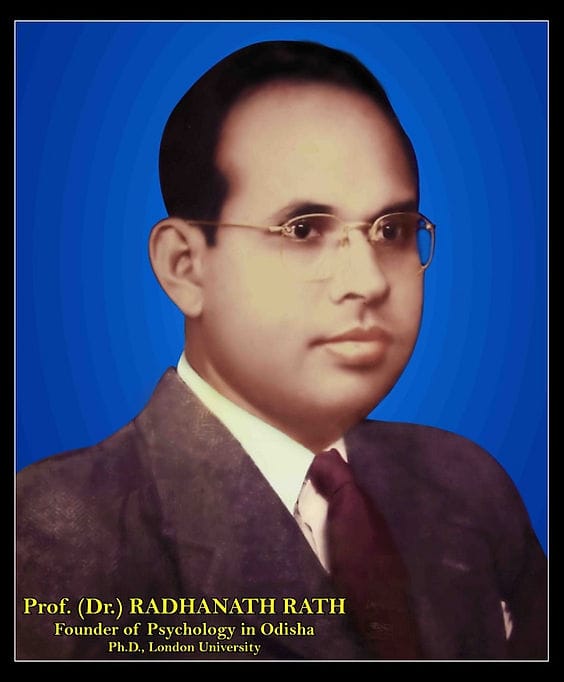
Prof. Radhanath Rath was an illustrious personality of modern India, who distinguished himself as a pioneering researcher and professor of psychology in India. As an educationist, researcher and litterateur unmatched by many of his contemporaries, he earned laurels for his state and the country from international circles of excellence in education. His tall erect frame, bald pate, gold-rimmed glasses and intellectual exuberance very well fitted into the image of a distinguished professor. A nationally and internationally renowned professor of psychology, Prof. Radhanath Rath left for his heavenly abode on 29th September, 2014 at the age of 96 at his residence in Cuttack, Odisha leaving behind a fully blossomed family and a host of students and ardent followers of his philosophy towards life.
Early Life and Education
Prof. Radhanath Rath was born in Talarampalli, a small village in Ganjam District, Odisha. He completed his Master's degree in Philosophy from Patna University in 1943 and began his teaching career as a Lecturer in Philosophy at Ravenshaw College in 1944. Driven by his passion for psychology, he joined Calcutta University as an external student to study under renowned psychologists like Dr. Girindra Sekhar Bose. His ambition led him to the University of London, where he pursued a Ph.D. in Experimental Psychology under Sir Cyril Burt, a well-known intelligence theorist, completing his doctorate in 1949.
Pioneering Psychology in Odisha
Upon returning to India, Prof. Rath was determined to establish psychology as an independent discipline in Odisha. Despite facing opposition, he successfully founded the Department of Psychology at Ravenshaw College in 1953, followed by the Postgraduate Department in 1958. His relentless efforts earned the department a national reputation, and under his leadership, the psychology department at Utkal University was recognized as the UGC's first Center of Advanced Study in Psychology in 1980.
Academic Contributions and Research
Prof. Rath’s research focused on socio-cultural issues, inter-caste tensions, stereotypes, and the effects of modernization. His pioneering work, such as the monograph Psycho-Social Problems of Social Change (1973), garnered international recognition. He was instrumental in shifting the department’s research focus towards cognitive and developmental psychology, with groundbreaking studies on the cognitive abilities of disadvantaged children. These efforts led to the creation of an Educational Psychology wing at Utkal University, which later became a Center of Advanced Study in Psychology.
Institutional Leadership and Legacy
Prof. Rath played a significant role in shaping psychology as a respected discipline in India. He served as the President of the Psychology Session at the Indian Science Congress and the President of the Indian Association of Applied Psychology. His leadership at Utkal University attracted scholars from around the world, turning the department into a nucleus for advanced psychological research. By the time he retired in 1981, the department had grown significantly, with numerous Ph.D. scholars and visiting professors contributing to its academic stature.
Social Reforms and Activism
In addition to his academic achievements, Prof. Rath was committed to improving education for marginalized communities. He spearheaded the Prathamika Sikhsha Vikas Andolana, which focused on reforming primary education in Odisha. His efforts led to the improvement of over 300 primary schools in the state. He also founded a residential school in his ancestral village, donating his land to support the education of nearly 500 students.
Global Recognition and Influence
Prof. Rath’s international contributions were significant, with visiting professorships at Concordia University (Canada), Birmingham University (UK), and Malmo University (Sweden). He was part of Indo-Russian cultural delegations and traveled to more than 20 countries, sharing his insights on psychology and promoting an Indian perspective in global psychological discourse. His collaboration with renowned figures like B. F. Skinner and Carl Jung further cemented his influence in both Eastern and Western psychological thought.
Literary Contributions
Prof. Rath’s literary talents were equally notable. He authored 27 novels, 12 books on psychology, 4 travelogues, and numerous essays. His autobiography, Mo Swapna Mo Jivana, earned him the Odisha Sahitya Academy Award in 1993. His novels, including Paalita Kanya, Saagara Sepaare, and Nagara Badhu, explored human psychology and were widely acclaimed. His travelogues, such as Bilata Diary and America Diary, captured his experiences abroad and further demonstrated his literary prowess.
Post-Retirement Activism and Legacy
After retiring in 1981, Prof. Rath continued to contribute to psychology and social reform. He led missions to improve elementary education in Odisha, served as a member of the Cuttack Development Authority, and was active in the Odisha State Child Protection Society. His work as a member of the Board of Secondary Education helped nationalize school textbooks in Odisha. He also wrote extensively for Odia newspapers, making psychology accessible to the common man through popular columns on psychological issues.
Conclusion: A Visionary Leader
Prof. Radhanath Rath’s contributions to psychology, education, and literature were profound and lasting. He blended academic rigor with social activism, leaving behind a legacy that continues to inspire scholars, teachers, and reformers. His pioneering efforts in establishing psychology as a respected discipline in India, coupled with his vast literary contributions, make him a unique and multifaceted figure in modern Indian history.